Rethinking Corporate Networking with NFC & IoT Standards
The statistics are damning: 10 billion business cards are printed annually. Within a week, 88% of them are thrown into the trash.
For decades, the “handshake protocol” of business has relied on dead trees and ink. At The Greenwise Agency, we viewed this not just as an environmental failure, but as a data transmission failure. Paper is static, un-trackable, and requires manual input (OCR) to enter a digital workflow.
In Q3 2025, we finalized the specifications for Focus One, our proprietary IoT device designed to replace the paper stack forever. Here is the engineering logic behind the shift.
The Hardware: Beyond a Simple Tag
While standard NFC (Near Field Communication) tags have existed for years, corporate deployment requires a higher standard of durability and security.
We built the Focus One architecture on the NTAG216 standard. Unlike cheaper generic chips, this specification allows for:
- 888 bytes of user memory: Enough to store complex vCard 3.0 profiles and encryption keys directly on-chip.
- Data Retention: 10 years of memory retention without a power source (passive RFID).
- 100,000 Write Cycles: A single card effectively lasts an entire career.
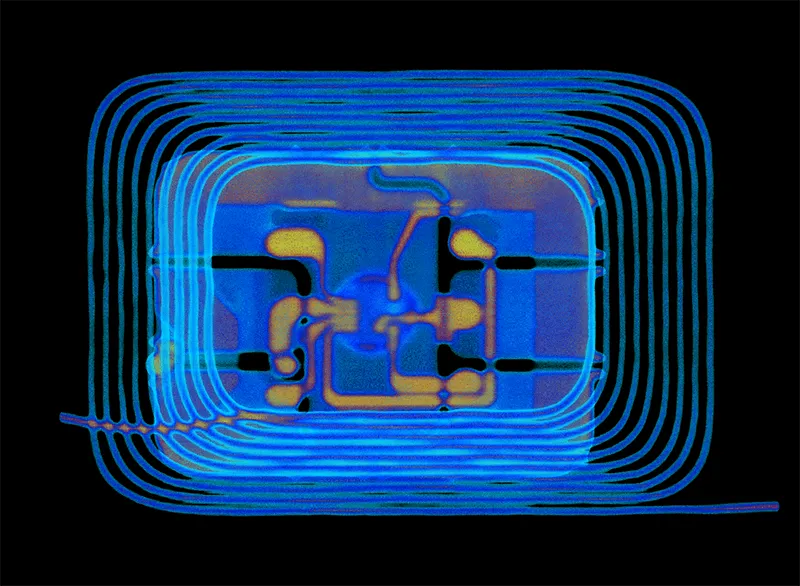 Figure 1: X-Ray analysis of the Focus One induction coil. The continuous copper loop ensures a stable 40mm read range without batteries.
Security & The “Handshake” Protocol
A common concern with IoT devices is security (“skimming”). We engineered Focus One with a short-range passive coupling limit. The device only activates within a 4cm field of a reader (smartphone), making accidental data leakage physically impossible.
Furthermore, the data pointer does not lead to a static URL, but to our The Greenwise Agency Dynamic Resolver. This allows us to:
- Update details remotely: If an employee changes roles, the card doesn’t need re-printing. The pointer remains, the payload changes.
- Analytics: Companies can finally track the ROI of their networking events (scan rates vs. CRM entries).
Material Science: Recycled PET & Wood
Hardware usually implies plastic waste. We challenged this paradox by sourcing rPET (Recycled Polyethylene Terephthalate) for the card body.
By utilizing post-consumer waste for the chassis, the carbon footprint of manufacturing one Focus One card is offset after just 14 uses compared to premium paper cards.
The End of “Manual Entry”
The friction of typing a phone number is where leads die. By standardizing the vCard 3.0 protocol via NFC, we reduce the “Time-to-CRM” from minutes to milliseconds.
This is not just about saving paper. It is about optimizing the physical layer of business communication.
Stop printing. Start connecting.